Stellar Project · Small-satellite systems

Small-satellite docking electronics

I supported Stellar Project in developing an engineering qualification model of a docking controller board. My work covered electronic design, embedded firmware, prototype bring-up and mechanism integration support.

Electronic designEmbedded firmwareSystem integration
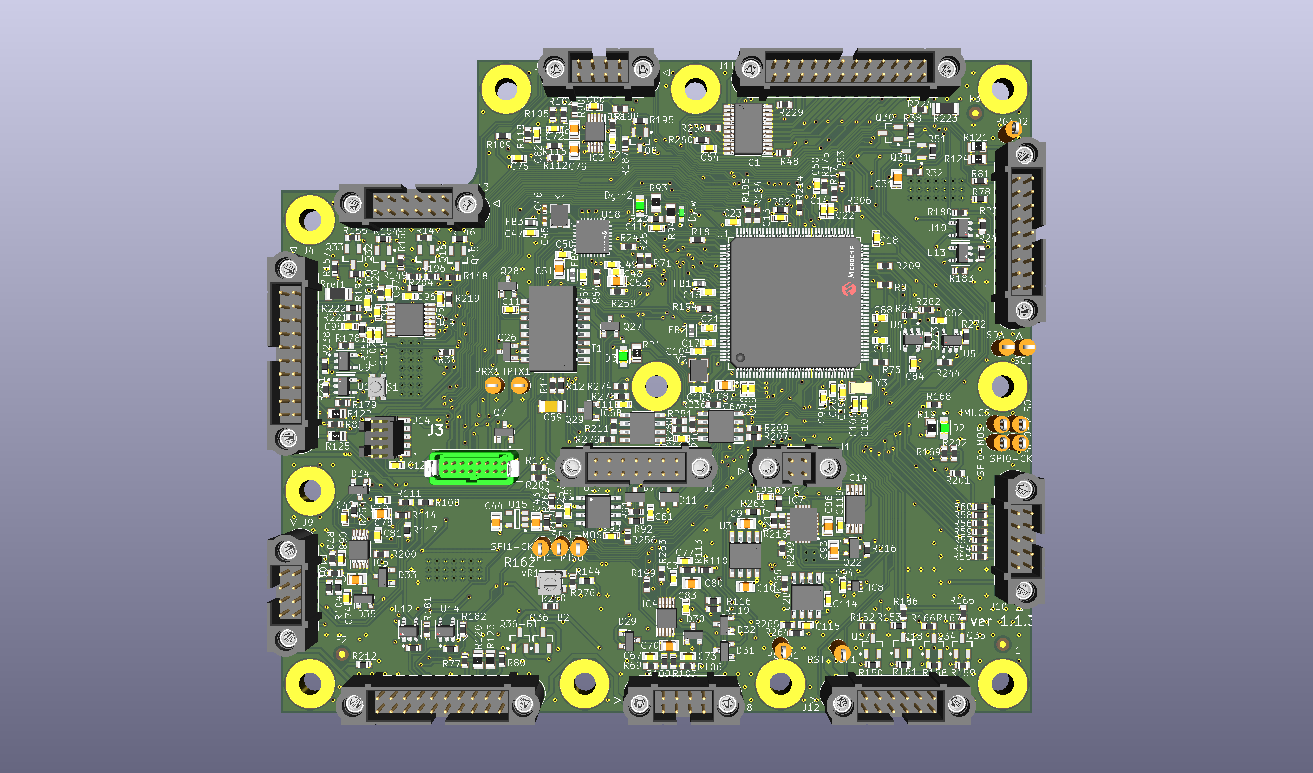
PCB rendering of the small-satellite docking controller electronic board
FIG. 01 // CONTROLLER BOARD EQM — PCB RENDERING

The problem

A controller within a mechanism.

The controller serves the active side of a docking mechanism for small satellites based on 12–16U CubeSat platforms dedicated to proximity operations, inspection, rendezvous and docking. Processing, communications and mechanism sensing had to fit the assembly’s mechanical, power, EMI and functional constraints.

The design requirements combined automotive-oriented component and manufacturing practices with ECSS-driven expectations for space hardware. These requirements affected component selection, design margins, PCB technology and the choice of suppliers.

My role

  • Supported Stellar Project in developing the controller-board engineering qualification model.
  • Designed the controller electronics, schematic and PCB.
  • Selected components and defined electronic interfaces.
  • Developed embedded firmware and dedicated board diagnostics.
  • Brought up reset, UART, I²C, GPIO expansion and sensing functions.
  • Debugged Ethernet, clocks, power rails and serial interfaces.
  • Supported integration of the controller with the docking mechanism.

Architecture

Processing, interfaces and sensing.

A Microchip ATSAMV71 microcontroller handles embedded control and diagnostics. The board provides Ethernet for system communication, UART for service access and diagnostics, and I²C-based digital I/O for distributed mechanism signals.

Mechanism-state and position-related sensing share the custom PCB with communications and control I/O. Their connections had to fit the complete assembly.

ATSAMV71 controllerEmbedded control · diagnostics
System connectivityEthernet · UART · I²C
Mechanism sensingDigital state · position-related signals

Engineering challenges

PCB requirements and integration.

Component and manufacturing requirements

Constraint

The board had to meet a mixed set of automotive-oriented component and manufacturing criteria and ECSS-driven requirements.

Engineering work

I considered component selection, design margins and PCB construction together, then checked the proposed PCB characteristics against candidate manufacturers’ capabilities.

Supplier checks

I verified that the selected PCB and manufacturing requirements were documented and supportable by the intended suppliers.

Mechanical, power and EMI constraints

Constraint

The mechanical envelope, available energy, power distribution, electromagnetic compatibility and required mechanism functions constrained the board architecture.

Engineering work

I evaluated schematic choices, PCB implementation, interface placement and sensing connections against the complete mechanism.

Result

A custom controller architecture with communications and mechanism sensing on the same board, designed around the system’s integration constraints.

Outcome

A representative controller EQM.

I supported Stellar Project through controller architecture, schematic and PCB design, embedded firmware, prototype bring-up and mechanism integration.

The resulting engineering qualification model is ready for system integration and representative of the form, fit and function of the flight unit. It combines network connectivity, service interfaces and mechanism-state sensing within the docking system’s constraints.

Technical summary

  • Microchip ATSAMV71 microcontroller
  • Ethernet connectivity
  • UART service & diagnostics
  • I²C-based digital I/O
  • Mechanism-state sensing
  • Digital state & position-related sensing
  • Custom PCB for mechanical, power & EMI constraints
  • Automotive-oriented / ECSS-driven design requirements